Video Ad Scripts by Duration — 15s, 30s, and 60s Templates You Can Copy
Copy-paste video ad script templates for 15 second, 30 second, and 60 second ads. What works at each duration, platform-specific guidance, and fill-in-the-blank scripts for any product.
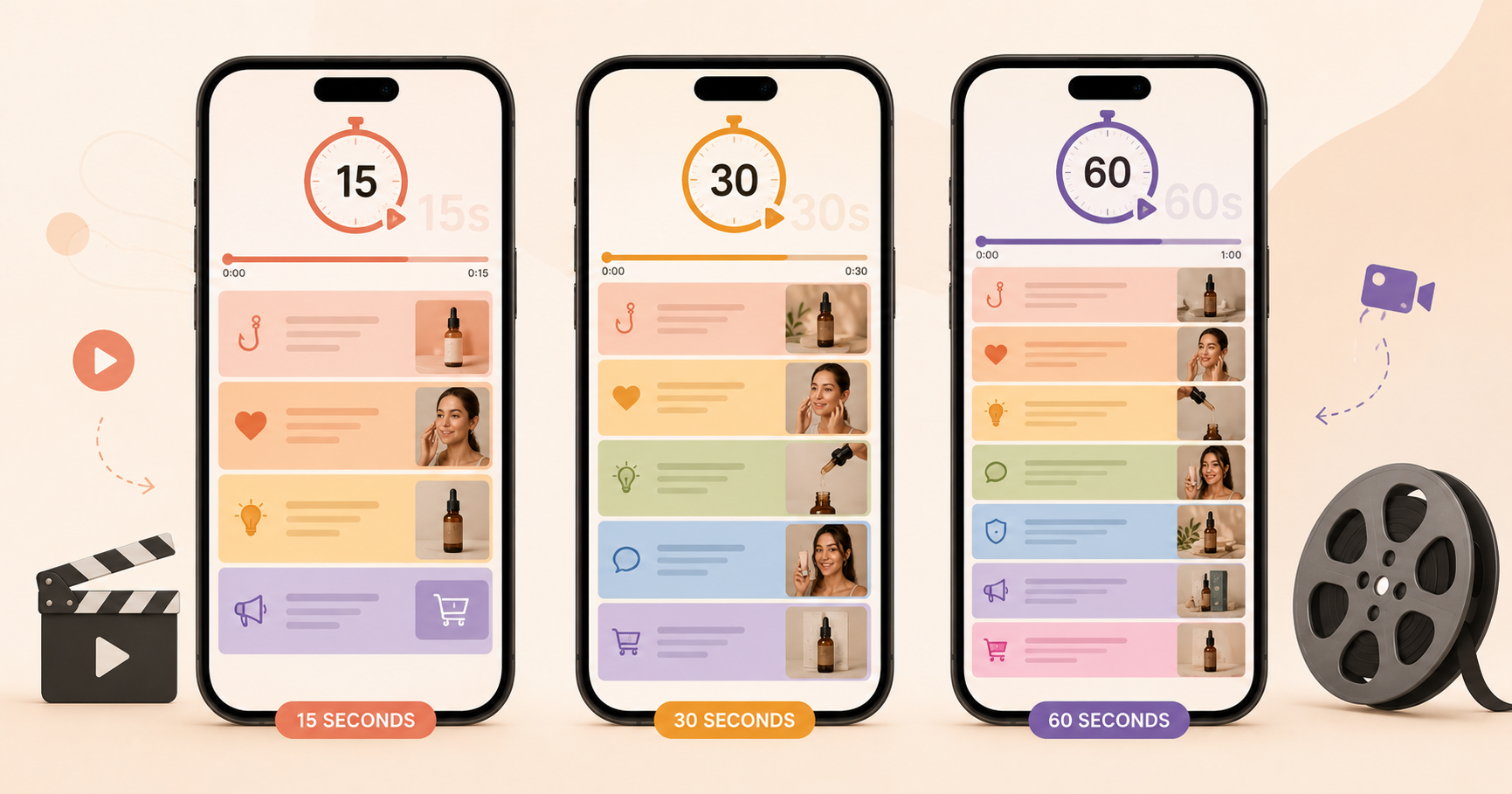
Table of Contents
Why Ad Script Length Matters More Than Most People Think
The duration of your video ad is not just a format decision, but it determines your entire creative structure. A 15-second ad and a 60-second ad have completely different jobs. Running a 60-second script structure in a 15-second slot means your CTA never lands. Running a 15-second script structure in a 60-second slot means 45 seconds of dead air that kills watch time and tanks your algorithm score.
This post gives you complete, copy-paste script templates for 15-second, 30-second, and 60-second video ads, plus guidance on which duration to use on which platform. Every template follows the same core framework, hook, problem, solution, CTA, but adapted to what is possible and what converts at each length.
These templates work for AI-generated video ads on inReels and for real creator content equally. If you want to understand the broader context of UGC ad scripting, the video ad scripts that convert post covers the principles behind these templates. This post is purely the templates themselves, just copy, fill in the brackets, and generate.
For understanding which format and structure to use beyond duration, the UGC ad frameworks for TikTok and Meta covers five proven ad structures with examples.
Which Ad Duration Should You Use on Each Platform?
Before the templates, a clear guide on duration by platform. Getting this wrong means your ad format is fighting the platform's user behavior rather than working with it.
| Platform | Recommended duration | Maximum | Notes |
|---|---|---|---|
| Instagram Reels | 15 to 30 seconds | 90 seconds | 15s for cold, 30s for warm |
| Instagram Stories | 15 seconds | 15 seconds | Hard limit, no exceptions |
| TikTok | 15 to 30 seconds | 60 seconds | Native feel matters more than length |
| Facebook Reels | 15 to 30 seconds | 90 seconds | Same as Instagram Reels |
| Facebook Feed | 15 to 60 seconds | 240 minutes | Longer works for considered purchases |
| YouTube Shorts | 15 to 30 seconds | 60 seconds | Same as TikTok behavior |
| YouTube In-Stream | 30 to 60 seconds | No limit | Skippable after 5s changes the math |
| Amazon Sponsored Brand | 15 to 30 seconds | 45 seconds | Muted autoplay — visual tells story |
The general rule: Cold audiences need shorter. Warm audiences tolerate longer. The more someone already knows about your brand and product, the more script you can get away with. For cold traffic on Reels and TikTok, 15 to 30 seconds is where almost every brand should start.
What Are the Best 15-Second Ad Script Templates?
Fifteen seconds forces ruthless efficiency. Every word has to earn its place. The structure at this length is: hook (2 seconds), one-line problem or context (3 seconds), product benefit (7 seconds), CTA (3 seconds). No padding, no extra beats.
Template 1: The Bold Claim (best for skincare, supplements, fitness)
"[Specific result] in [timeframe]. I didn't believe it either. [Product name] — I've been using it every morning for [duration] and [specific change]. [CTA — link in bio / shop now / use code X]."
Example filled in: "Zero breakouts for six weeks. I didn't believe it either. The Ordinary niacinamide serum — been using it every morning for 8 weeks and my skin texture changed completely. Link in bio."
Word count: 38 words. Comfortably under the 15-second limit at natural speaking pace.
Template 2: The Problem Opener (best for pain point products)
"If [relatable problem], you need to hear this. [What changed since finding the product] — and [specific result]. [CTA]."
Example filled in: "If you've been waking up exhausted even after 8 hours, you need to hear this. I started taking this magnesium three weeks ago — and I haven't hit snooze once since. Link in bio."
Word count: 42 words.
Template 3: The Direct Recommendation (best for impulse products)
"Honest recommendation: [product name]. [One sentence on what it does]. [One sentence on the result]. [CTA]."
Example filled in: "Honest recommendation: this back support cushion. Sits in any chair, redistributes pressure off your lower spine. I stopped getting that 3pm backache within a week. Link in bio."
Word count: 36 words.
Template 4: The Reaction Hook (best for beauty and transformation products)
"Wait — [reaction that stops the scroll]. [Product]. [What it does in one sentence]. [CTA]."
Example filled in: "Wait — my skin hasn't looked like this since I was 20. Vitamin C serum. One drop, every morning, 4 weeks. Link in bio."
Word count: 28 words. With natural delivery pauses this fills 15 seconds comfortably.
What Are the Best 30-Second Ad Script Templates?
Thirty seconds is the most versatile ad length. Long enough to deliver a complete problem-solution arc, short enough to hold attention on Reels and TikTok. This is where most brands should start for cold audience testing.
The structure at 30 seconds: hook (3 seconds), problem or context (7 seconds), product solution with one specific result (15 seconds), CTA (5 seconds).
Template 1: The Before and After Script (best for transformation products)
"[Specific result] — and I want to tell you exactly how. For [duration], I dealt with [specific problem]. Tried [what they tried]. Nothing worked. [How they found the product]. [What they did]. [Specific result that happened]. [Product name]. [CTA]."
Example filled in: "My skin finally cleared up — and I want to tell you exactly how. For three years, I dealt with hormonal breakouts along my jawline. Tried every serum, every prescription. Nothing touched it. My dermatologist mentioned niacinamide. I found The Ordinary's version, used it every morning. Six weeks later, zero active breakouts. Link is in my bio."
Word count: 76 words. Right at the limit for 30 seconds at conversational pace.
Template 2: The Skeptic Script (best for saturated categories)
"I almost didn't try this. Genuinely thought it was another gimmick. [Product category] is so full of overpromising products that I'd basically stopped believing any of them. [What made them try it anyway]. [What happened]. [Specific detail that makes it believable]. [Product name]. [CTA]."
Example filled in: "I almost didn't try this. Genuinely thought it was another gimmick. The supplement space is full of products that promise everything and deliver nothing. I'd basically given up. My gym partner had been on it for 6 months and I finally asked. Started taking it 8 weeks ago. My recovery time between sessions cut in half. AG1. Link is in my bio."
Word count: 84 words. Slightly fast at conversational pace — cut one sentence if needed.
Template 3: The Discovery Script (best for products found organically)
"So this came up on my feed three weeks ago and I kept scrolling past it. Finally tried it last month because [reason]. And [what happened]. [Specific detail that sounds real, not marketing-speak]. Still using it every day. [CTA]."
Example filled in: "So this ice roller came up on my feed three weeks ago and I kept scrolling past it. Finally tried it last month because my face was puffy every morning. And within five days the puffiness was gone before I even had coffee. It's now the first thing I do after washing my face. Still using it every day. Link in bio."
Word count: 73 words.
Template 4: The Specific Number Script (best for results-driven products)
"[Specific number or result] — and here is what actually changed. [Timeframe]. [What they were dealing with]. [What they tried that didn't work]. [Product entered]. [Specific number or result with a detail that grounds it]. [CTA]."
Example filled in: "Twelve pounds in nine weeks — and here is what actually changed. Not my diet, not my gym schedule. Both stayed the same. Added this to my morning routine in January. By mid-March my clothes fit differently. The only variable was this. Link is in my bio."
Word count: 59 words. This one has natural pauses built in so it fills 30 seconds even at a relaxed pace.
What Are the Best 60-Second Ad Script Templates?
Sixty seconds is appropriate for products that require explanation before the buyer can make a decision — supplements with a mechanism, tools with a workflow, products in crowded categories where the differentiator needs more than a sentence. On Facebook Feed and YouTube in-stream, 60-second ads can outperform shorter ones for considered purchases.
The structure at 60 seconds: hook (3 seconds), deeper problem setup (10 seconds), story or context (15 seconds), product introduction and how it works (20 seconds), result with specifics (7 seconds), CTA (5 seconds).
Template 1: The Full Story Script (best for high-consideration products)
"[Hook — specific result or reaction]. [Set up the problem in detail. Give it context. Make the viewer feel it.] [What they tried before. Why it did not work.] [How they found the product. First skepticism.] [What they did. How long. What started to change.] [The specific result. One concrete detail that makes it real.] [What they would tell someone in the same situation.] [Product name]. [CTA]."
Example filled in: "I stopped waking up at 3am — and I've had insomnia for four years. Not the occasional bad night. I mean lying awake for hours, checking the clock, calculating how much sleep I could still get if I fell asleep right now. Every. Single. Night. Tried melatonin. Tried sleep restriction therapy. Tried cutting caffeine completely. Nothing stuck. Someone in a Reddit thread mentioned magnesium glycinate. I figured it was worth the $20 to try. First week, nothing dramatic. Second week I noticed I wasn't waking at 3. Third week I slept through completely for the first time in months. I'm not saying it works for everyone. But if you've tried everything else and still can't sleep, this is what I wish someone had told me earlier. Natural Vitality Calm. Link in my bio."
Word count: 158 words. At a natural speaking pace with pauses this fills 55 to 65 seconds.
Template 2: The Comparison Script (best for products replacing expensive alternatives)
"[What they used to spend / do / use — and the number]. [How long they did it. What they got from it.] [What made them look for an alternative.] [How they found the product. Initial reaction.] [The comparison: what is the same, what is better, what is cheaper.] [How long they have been using it now. Current status.] [The number again — what they are saving or gaining.] [Product name]. [CTA]."
Example filled in: "I was spending $180 a month on a personal trainer. For two years. Great trainer. I got results. But $180 every month adds up and I started doing the math. Started looking for something that could replace the structure without the cost. Found this app. Thought it would be a watered-down version of the real thing. The programming is more detailed than what my trainer gave me. The form feedback from the AI coach is faster than waiting for him to come over. And I can train at 6am without booking a slot. I've been on it for four months. My strength numbers are up. My cost is $15 a month. That's $165 back in my pocket every month. Future. Link in bio."
Word count: 142 words.
Template 3: The Educational Script (best for complex or misunderstood products)
"[Common misconception about the product category — state it plainly]. [Why that misconception exists — be empathetic, not condescending]. [What is actually true — the real mechanism]. [Product as the embodiment of that truth]. [How they use it and what they do with the result]. [Specific outcome or change]. [CTA — framed as giving the viewer the same knowledge]."
Example filled in: "Most sunscreens feel terrible on your skin. That's not a personal preference problem — it's a formulation problem. Most affordable sunscreens use older chemical filters that pill under makeup, leave a white cast, and break down in humidity. Brands have known this for years and kept making the same thing because it is cheaper. A new generation of mineral-chemical hybrid filters changed this. No white cast, no pilling, water-resistant without that sticky feel. I found this one six months ago and have worn SPF every single day since — which I could never manage before. EltaMD UV Clear. If you've given up on sunscreen because of how it feels, this is the one to try. Link in bio."
Word count: 134 words.
How Do You Use These Templates Effectively?
These templates are starting points, not finished scripts. The difference between a template that converts and one that does not is how specifically you fill in the brackets.
The most important principle: every blank should be filled with a specific, real detail rather than a generic one. "[Specific problem]" filled with "skin issues" produces a weak script. "[Specific problem]" filled with "the hormonal breakouts that showed up every month in the same spot on my chin" produces a script that makes the target audience feel seen.
Read the filled-in template out loud before generating the video. If you pause at any point because something sounds unnatural, rewrite that sentence. Conversational speech has shorter sentences, more contractions, and more pauses than written text. The script should sound like something you would say to a friend who asked you about the product.
For AI-generated video ads, shorter sentences within the script produce better lip-sync results. Where you have a long compound sentence, break it into two. The avatar reads naturally at about 130 words per minute — use that as your calibration for whether your word count fits the duration.
Once you have a working script from one of these templates, create two to three hook variations using different first sentences. Keep everything else identical. This gives you testable creative variations without having to rewrite the entire script. The UGC ad KPI benchmarks guide covers which numbers to watch to find the winning hook within the first 48 hours of running.
Frequently Asked Questions
How many words should a 30-second video ad script have?
At a natural conversational speaking pace, the average person speaks around 130 words per minute. For a 30-second ad, that is approximately 65 words. Aiming for 60 to 80 words gives you room for natural pauses without rushing. Reading your script out loud and timing it is the most reliable method if you consistently run over 30 seconds when reading naturally, cut the script rather than speeding up the delivery.
Can I use the same script for Meta and TikTok?
Yes, with minor adjustments. The core structure works on both platforms. What changes is the energy and pacing. TikTok native content tends to be slightly faster-paced with a more immediate hook. Meta audiences tolerate a slightly slower build. If your script starts with a 3-second hook and moves quickly to the problem, it will work on both. If the hook takes 5 seconds, it is too slow for TikTok.
Should I write different scripts for different products?
Yes, always. A script template gives you the structure, with the specific product details, the specific problem, the specific result, must be unique to your product and your audience. Using a skincare script template for a supplement without changing the problem and result language produces a generic ad that does not connect with anyone. Fill in every bracket with real, specific details about your actual product.
How do I make my script sound less like an ad?
Three edits that make almost every script more human: replace "I" with specific descriptions ("I noticed" instead of "I experienced"), cut any sentence containing the words "innovative," "revolutionary," "game-changing," or "amazing," and add at least one specific number or timeframe that a real person would remember ("six weeks" rather than "a few weeks," "three times a week" rather than "regularly"). These changes alone move most scripts from sounding like marketing copy to sounding like a real person talking.
Which script template converts best?
The Before and After script and the Specific Number script consistently rank among the highest converters across product categories because they lead with proof rather than claims. The Skeptic script is particularly effective in saturated categories where the audience has been burned by similar products before. The Discovery script works well on TikTok where organic-feeling content performs best. The right answer for your product is to test two or three and let CTR data tell you which one your specific audience responds to.
How many script variations should I test at once?
Start with three variations using different hooks on the same base script. Running more than five variations simultaneously dilutes your budget too thin to generate statistically meaningful data on any single variation. Find the winning hook first, then test script variations, then test avatars. One variable at a time produces cleaner data and faster decisions.
Turn These Scripts Into Finished Video Ads Today
Copy any template above, fill in the brackets for your product, and generate a finished video ad in minutes on inReels. Script, avatar, voice, lip sync, and 9:16 export handled automatically. Plans start at $9 per month.
The free AI UGC video generator lets you test with one script before committing to a subscription.
For the hook formulas that make these scripts stop the scroll, the UGC hooks that stop the scroll guide has 30 templates organized by product type. For the five broader script structures these templates are built from, the UGC ad frameworks for TikTok and Meta covers each framework with examples.
Start Creating Video Ads Today
Create UGC-style video ads in minutes. No creators, no waiting, no expensive production. Perfect for TikTok, Instagram Reels, YouTube Shorts, and more.
Try inReels Free →No credit card required