Talking Head Ads — The Format Dominating Social in 2026
Talking head ads are the highest-performing format on Meta and TikTok right now. Here is why they work, what makes them convert, and how to make one with AI in under 10 minutes.
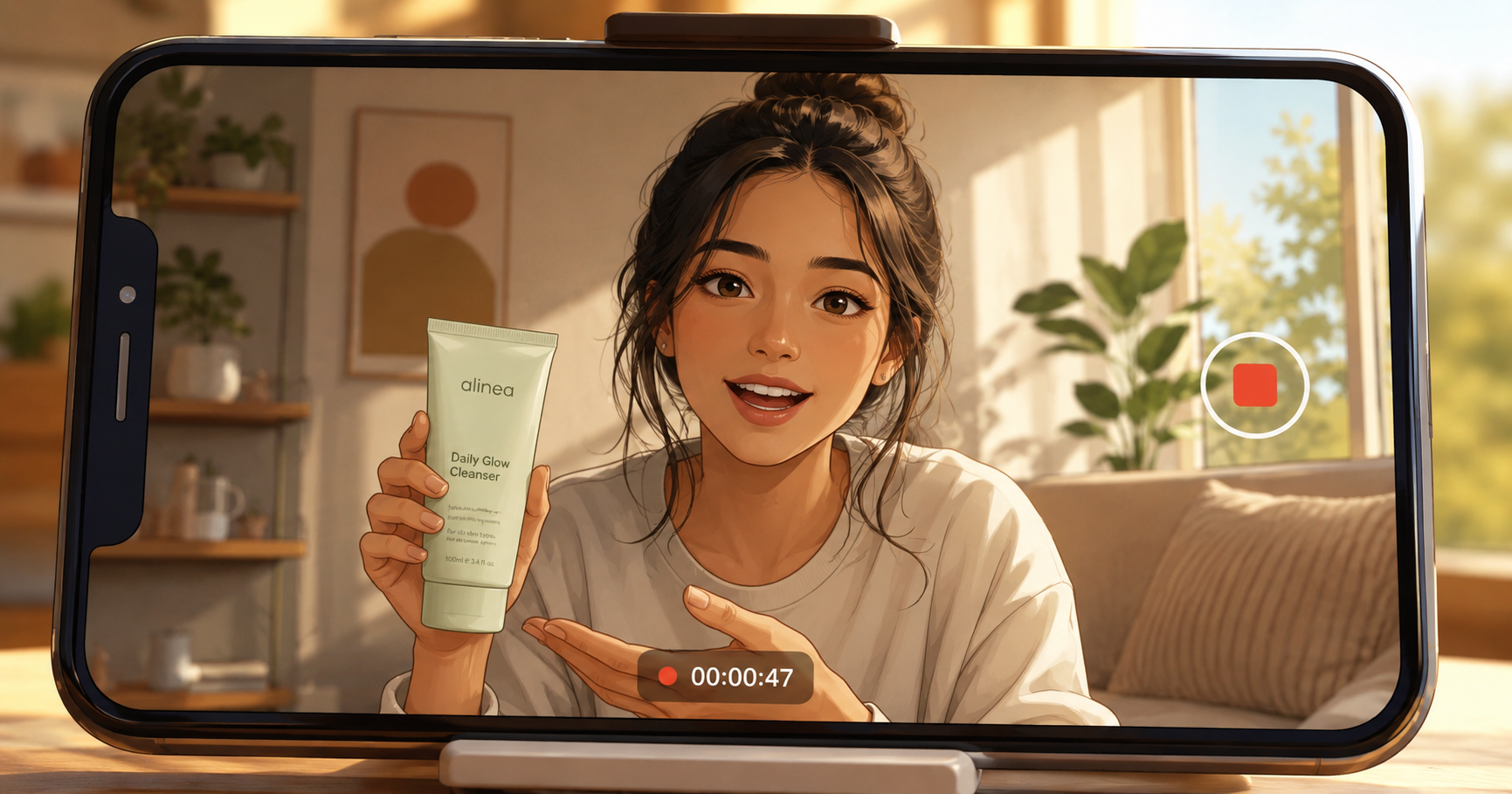
Table of Contents
What Is a Talking Head Ad?
A talking head ad is a short video of one person speaking directly to camera about a product. No fancy cuts, no studio setup, no branded motion graphics. Just a face, a product, and a script delivered like a real person talking to a friend. It is the highest-performing ad format on Meta and TikTok right now — and with AI, any brand can produce one in under 10 minutes without a single creator on payroll.
If you want to see how this fits into the broader UGC ad landscape, the best AI UGC ad generators in 2026 post covers the tools making this possible. This guide focuses on why talking head ads work and exactly how to make one.
Why Do Talking Head Ads Outperform Every Other Format?
The data on this is consistent. Across Meta, TikTok, and YouTube Shorts, talking head style UGC ads generate 2 to 4x higher click-through rates compared to polished branded video. Cost per click drops significantly. Return on ad spend improves because the media spend is working harder.
The reason comes down to one thing: people are wired to pay attention to faces. When a face appears on screen and speaks directly at you, your brain treats it like a conversation. You stop scrolling. You listen. That half-second of attention is everything in paid social.
Polished brand ads announce themselves as ads. A talking head video that looks like something a real person posted looks like content. Audiences lower their guard before they realize they are watching a pitch.
The second reason is trust. When a real person — or a believable AI avatar — holds a product and talks about it from experience, it carries more credibility than a product shot with a voiceover. Even if a viewer suspects it could be AI-generated, the format creates a closer approximation of a personal recommendation than anything else running in paid social right now.
What Is the Anatomy of a Talking Head Ad That Converts?
Every talking head ad that converts has the same four-part structure. The timing varies with ad length but the sequence never changes.
The Hook (0 to 3 seconds)
The hook is everything. If you do not stop the scroll in the first 2 to 3 seconds, nothing else matters. The person says something that creates immediate curiosity or speaks directly to a pain point the target audience recognizes.
What works: specific claims, unexpected statements, relatable frustration. "I have not had a breakout in six weeks" works. "Let me tell you about my skincare routine" does not. The hook has to make someone think "wait, what?" before their thumb finishes the swipe. See the UGC hooks that stop the scroll post for 30+ templates by product type.
The Problem (3 to 10 seconds)
After the hook, the best talking head ads make the viewer feel seen. They describe the situation — the frustration, the thing that was not working before — in language that sounds like a real person, not a brand. If someone watches these 7 seconds and thinks "that is exactly my situation," they will watch the rest.
The Solution (10 to 22 seconds)
This is where the product comes in. Not a feature list. A simple explanation of what it does, delivered as personal experience. "I started using this and within two weeks the difference was noticeable" carries more weight than "this product contains 10% niacinamide." Specifics — timelines, results, comparisons to what they tried before — make this section believable. For more on scripting this section, see video ad scripts that convert.
The CTA (22 to 30 seconds)
One instruction. Clear and direct. "Link is in my bio" for organic repurposing. "Tap the link below" for paid placement. "Use code X for 20% off" if you need a measurable conversion signal. One CTA, not three. The ad has done its job by this point.
How Do You Make a Talking Head Ad with AI?
The process takes three inputs and about 10 minutes.
What you need:
- A product description or URL
- A script following the four-part structure above
- An AI avatar tool like inReels
The process:
Write or generate your script first. Keep it under 90 words for a 30-second ad. Read it out loud. If any sentence sounds like marketing copy, rewrite it in first person as if you were telling a friend about the product.
Pick your avatar based on your target customer, not your personal preference. On inReels, you can use any of the existing avatars or upload your own image — your face, a team member, anyone who fits. You can also select from a range of voices to match the character. The closer the avatar looks and sounds to your target customer, the stronger the identification effect when your audience watches.
Generate the video. Behind the scenes, AI tools handle the hard part — lip-syncing the avatar's mouth, eyes, and head movement to the audio. The technology powering this (models like HeyGen's lip-sync engine, Fabric, OmniHuman, and others) has improved dramatically. You don't need to worry about which model is running — tools like inReels select the best one automatically. The output is a finished video in 9:16 format ready for Reels or TikTok. Generation takes 3 to 5 minutes.
Add captions before you export. Around 85% of people on Instagram and TikTok watch without sound. Captions are how most of your audience will actually consume the ad.
For a more detailed walkthrough of each step including hook writing and avatar selection, the step by step guide to creating UGC ads with AI covers the full process.
What Do Talking Head Ads Look Like by Product Category?
The format works across almost every physical product category but the script angle changes depending on what you are selling.
Skincare and Beauty
The highest-performing angle for beauty products is the before-and-after testimony. The avatar describes their skin situation before — breakouts, dryness, uneven texture — and then explains what changed. The product is the turning point in the story.
Hook that works: "My dermatologist actually asked me what I changed in my routine."
Supplements and Health Products
The trust bar is higher here because the claims have to be careful. The angle that works best is the lifestyle shift. Not "this supplement fixed my energy" but "I started taking this three months ago and my afternoon slumps basically disappeared." Specific, personal, measured.
Hook that works: "I have tried every energy supplement on the market. This is the first one where I actually felt the difference."
Fashion and Accessories
The talking head format works best when the avatar is wearing or holding the product, not just talking about it. Lead with a specific problem the product solved — "I could never find a bag that fits my laptop and also looks good at dinner" — and the product is the answer.
Hook that works: "I have returned every bag I bought in the last two years. Not this one."
Home and Kitchen Products
The demo angle works well here. The avatar describes the problem they had with their old solution, then shows or explains how this product fixed it. Specific use cases land better than general benefit claims.
Hook that works: "I thought I was just bad at cooking until I realized my pan was the problem."
For five proven script frameworks with examples across these categories, the UGC ad frameworks for TikTok and Meta post covers before-and-after, problem-agitate-solve, story arc, reaction, and listicle formats.
What Separates Good Talking Head Ads from Bad Ones?
Most talking head ads underperform not because of production quality but because of the script. Here is the pattern that shows up consistently.
| What bad talking head ads do | What good ones do instead |
|---|---|
| Lead with the product name and brand | Lead with a pain point or a specific claim |
| Use marketing language ("game-changing", "innovative") | Use human language ("honestly I was skeptical at first") |
| List features | Describe experiences and results |
| Three different CTAs | One clear instruction |
| Run 45 to 60 seconds on a first test | Run 15 to 30 seconds and get to the point |
| Generic avatar with no demographic match | Avatar that looks like the target customer |
| No captions | Captions always on |
| Too polished — studio lighting, perfect framing | Raw and natural — kitchen, sofa, car, everyday setting |
The biggest trap with AI talking head ads is making them too polished. When the avatar looks like a news anchor in a studio with perfect lighting, it stops feeling like UGC and starts feeling like a documentary or a corporate video. People scroll past that. The whole point of a talking head ad is that it looks like someone grabbed their phone and started talking because they genuinely had something to share.
The setting matters. A bedroom with natural light, a kitchen counter, a car seat — these are where real people actually record content. The script matters even more. If it reads like a press release delivered by a polished avatar, you have a professional video, not a UGC ad. Keep it raw. Keep it conversational. Match the avatar and the script to the message you want to convey — someone sharing a real experience, not presenting a pitch.
How Much Does It Cost to Make a Talking Head Ad?
The cost difference between traditional and AI-generated talking head ads is significant.
| Production method | Cost per video | Turnaround time |
|---|---|---|
| Freelance UGC creator (marketplace) | $150 to $500 | 7 to 14 days |
| Boutique UGC agency | $400 to $1,200 | 10 to 21 days |
| In-house creator or employee | $50 to $150 time cost | 1 to 3 days |
| AI talking head tool (inReels) | $0.50 to $3 per video | 5 to 10 minutes |
The cost advantage of AI is most significant when you are running creative testing at volume. A brand testing 10 hooks for the same product would spend $1,500 to $5,000 with real creators and wait two weeks. With AI, the same 10 variations cost under $30 and take an afternoon.
Real creator UGC still has advantages in certain scenarios — genuine testimonials, niche communities where authenticity matters enormously, products that require real hands-on demonstration. The two approaches work best together: use AI for creative testing and reserve real creator spend for scaling the hooks that win. The AI UGC vs real creator comparison has a detailed breakdown of when to use which.
Frequently Asked Questions
What is the ideal length for a talking head ad?
For cold audiences on Meta and TikTok, 15 to 30 seconds is the sweet spot. Shorter than 15 seconds and you do not have enough time to build the problem-solution arc. Longer than 30 seconds and you lose the majority of viewers before the CTA. For retargeting audiences who already know your brand, you can go up to 45 seconds, but test shorter versions first.
Do talking head ads work for B2B products?
They work better than most B2B marketers expect, especially on LinkedIn and YouTube pre-roll. The format changes slightly — the avatar is more professional, the hook focuses on business outcomes rather than personal experience, and the CTA points to a demo or free trial rather than a purchase. The structure and psychology are the same.
How do I make my AI talking head ad look less artificial?
The biggest giveaway in AI talking head ads is an unnatural script, not the video quality. Read your script out loud before generating. Cut any sentence that sounds like it came from a product brochure. Add small imperfections — a slight pause, casual phrases like "honestly" or "look" — that real speakers use. A conversational script with a high-quality AI avatar is genuinely difficult to detect on a mobile screen.
What background works best for a talking head ad?
The background that works best is one that matches where your target customer lives. For skincare targeting women 25 to 35, a warm sunlit bedroom is more effective than a clean studio. For a productivity app, a home office setup. The background is part of the authenticity signal. Avoid pure white or obvious studio setups unless your brand is explicitly premium and clinical.
How many talking head ads should I create for a new campaign?
Start with 3 to 5 variations testing different hooks. Keep everything else constant — same avatar, same product, same CTA — and only change the first 3 seconds. This gives you clean data on which hook resonates. Once you find the winning hook, iterate on the script, avatar, and CTA as separate experiments. The UGC ad KPI benchmarks guide covers what to look at in the first 48 hours.
Can AI talking head ads run on Meta without issues?
Yes. Meta allows AI-generated content in ads. As of mid-2026, Meta's guidance requires a disclosure label on AI-generated content that could be mistaken for a real person. This is straightforward to add in Ads Manager and has not shown a material impact on performance in testing. Always check Meta's current policies before launching as these update frequently.
Make Your First Talking Head Ad Today
The format works. The cost is low. The barrier to testing is almost zero. inReels lets you go from a product description to a finished talking head ad in under 10 minutes — script, avatar, voice, and lip sync handled automatically.
If you want to see the output quality before committing, the free AI UGC video generator lets you run a test without signing up.
And if you are still figuring out which ad format fits your product best, the video ad formats that actually convert post compares talking head, before-and-after, product showcase, and demo formats side by side.
Start Creating Video Ads Today
Create UGC-style video ads in minutes. No creators, no waiting, no expensive production. Perfect for TikTok, Instagram Reels, YouTube Shorts, and more.
Try inReels Free →No credit card required